August was our biggest launch month yet: eleven new APIs across Booking.com, Google Flights Deals, Instagram, TikTok, YouTube, and AutoScout24, plus a long list of engine improvements across Google, Amazon, Bing, Walmart, TikTok, and more.
Ratings - rating, max_rating, rating_word, reviews, top_review_category, and is_guest_favorite, plus external_rating and external_reviews.
Availability - rooms_left, has_free_cancellation, free_cancellation_until, has_no_prepayment, and is_sold_out.
Filters & Pagination - A response-derived filters block lists every option Booking.com offers for that search, alongside pagination, search_information.total_results, and the resolved destination.
Flexible Dates - search_information.flexible_dates reports the months, nights, and start_day a flexible search covered.
Property Information - The property_information object provides name, description, address (street, city, region, postal code, country), property_type, hotel_class, brand, rating, max_rating, reviews, review_breakdown, check_in_time, check_out_time, gps_coordinates, images, and languages_spoken.
Rooms - The rooms array provides name, bed_configuration, price, extracted_price, currency, room_size, max_guests, max_children, bathrooms, and bed_options.
Review Summary - The review_summary object returns Booking.com’s AI-written highlights, pros, and cons, alongside review_topics with per-topic sentiment and mentions.
Featured Reviews - The featured_reviews array provides author, country_code, title, liked, disliked, rating, language, travel_type, and trip_type.
Policies - amenities, house_rules, meals, fine_print, and faqs.
Nearby Places - The nearby_places block covers restaurants, attractions, public transport, beaches, and airports with distances, plus a separate nearby_beaches list.
The Google Flights Deals API returns ranked round-trip deals from an origin airport: Google’s “deals to anywhere” view. It includes:
Deals - The deals array provides position, destination, origin, outbound_date, return_date, trip_length_days, price, stops, flight_duration, airline, airline_code, booking_link, and is_round_trip.
Savings Signals - Each deal carries typical_price, savings_percentage, and savings_amount so you can tell a real deal from a normal fare.
AI Destination Curation - The q parameter takes a free-text prompt (“beaches and islands”), and Google picks the destinations.
Filters - max_price, stops, travel_class, included_airlines, currency, and hl narrow the search. Note that q and the filters are mutually exclusive. Google honors a prompt or the filters, never both, so sending them together returns a validation error rather than a billed response with filters that were silently ignored.
The Instagram Post API returns a public Instagram post, reel, or carousel by its shortcode. It includes:
Post Data - The post object provides id (the shortcode), media_id, permalink, type, link, width, height, duration, has_audio, accessibility_caption, and the caption text.
Media Versions - image_versions and video_versions return every size Instagram serves, plus a thumbnail.
Carousels - carousel_items returns each slide with its own type, dimensions, and media links.
Author - The user object provides id, username, name, avatar, is_verified, and is_private.
Comments - The comments array provides position, id, text, iso_date, likes, and user (id, username, avatar, is_verified). Comments posted as a GIF or sticker carry an image instead of text.
The Post - Page one also returns the full post object, so a single call gives you the media and its comments.
Pagination - pagination.next_page_token walks the full thread; search_information.total_results reports the comment count.
We kept the post object exactly the same as in the Instagram Post API for easier migration.
The TikTok Video API returns a single public TikTok video, photo post, or carousel from a URL, or from video_id plus username. It includes:
Video Data - The video object provides id, link, caption, language, iso_date, duration, width, height, type (video, photo, or carousel), thumbnail, hashtags, and mentions.
Engagement - views, likes, comments, shares, and saves.
Media Detail - video_meta (definition, ratio, format, codec, size, bitrate, fps), music (title, author, cover, duration, play URL, is_original), and subtitles per language.
Carousels - Photo posts return a title plus carousel_items with per-slide image and dimensions.
Author - The author object provides id, username, name, bio, avatar, is_verified, is_private, followers, following, hearts, and posts.
We kept keys exactly the same as in the TikTok Profile Videos API for easier migration.
The TikTok Transcripts API returns timestamped caption segments for a TikTok video. It includes:
Transcripts - The transcripts array provides text, start, and duration for each segment.
Language Selection - The language parameter picks a track, and available_languages lists every track TikTok published for that video with name, lang, and is_selected.
Same Inputs - Accepts the same url or video_id + username as the TikTok Video API.
Filters - make, model, price_min/price_max, mileage_min/mileage_max, registration_year_min/registration_year_max, power_min/power_max with power_unit, fuel_type, transmission, body_type, seller_type, condition, zip + radius, and sort_by.
Eight Marketplaces - The country parameter covers de, at, be, es, fr, it, lu, and nl, and pins the request to that market.
Available Options - A response-derived filters block returns the makes and sort options AutoScout24 offers for that search, alongside pagination.
Depth - AutoScout24 caps browsing at 200 pages (4,000 results) per query regardless of the total match count, so narrow with filters for deeper inventory.
We added MCP tools for the new engines: Instagram Post, Instagram Comments, TikTok Video, TikTok Transcripts, and Google Flights Deals to join the existing bundles, and AutoScout24 gets a bundle of its own. We also fixed our MCP server being rejected by Anthropic’s connector, so claude.ai custom connectors and the API mcp_servers parameter work again.
Email Invoices
You can now opt in to Email Invoices in your billing settings, and every receipt arrives with the invoice PDF attached, showing plan, billing period, amount, date, and payment method.
⚙️ Engine Improvements:
Google
Added train_results. The train schedule widget for queries like “trains from London to Manchester”, with times, duration, transfers, price, operator, and booking links. Field names match the Google Maps Directions transit output, so you can switch engines without remapping
Added the link request parameter. Google now wraps many result links in encrypted redirects; link=resolved decodes them in organic_results sitelinks, related_questions.reference_links, and ai_overview.reference_links, though it might return the real destinations at the cost of speed
Recovered the advertiser URL in ads[].link for Google’s new encrypted ad links
Fixed inline_videos[].key_moments[].link
Fixed perspectives - link was empty on every item on a new Google layout, and date was being reported as reactions
Fixed AI Overview text_blocks and reference_links
Google Ads Transparency Center
domain now accepts a pasted URL
Google Ads Transparency Center Ad Details
Added is_playable and html5_link so HTML5 playable ads and uploaded HTML5 banners are identifiable in variations
Google AI Mode
Fixed answers being cut short
Fixed reference_links returning Google’s encrypted redirect instead of the real URL
The “no response available for this search” placeholder is now detected in every language, instead of returning a partial answer
Google AI Overview
Added the link=resolved parameter for encrypted reference links
Fixed reference_links on the new sources panel, including Shopping product references
Google Events
Migrated to Google’s new events layout after Google retired the old one, so results are back
Added gl for country targeting: location, uule, and gl are mutually exclusive
Google Hotels
bounding_box is now kept while paginating: deep pages no longer drift outside the box
Fixed type mislabeling hotels as vacation_rental
city is now read per property instead of from the search location
Added search_information.is_location_fallback to flag pages Google padded with country-wide results
Google Lens
Fixed result link and related_searches[].link resolving against the wrong Google host, including Google’s encrypted redirects
Google Maps
Days with split hours now return every interval in open_hours (for example 12–8 AM, 6 PM–12 AM) instead of only the first
Google Maps Place
Same open_hours fix on place results and at-this-place results
Google Maps Reviews
Restored the topics block (id, keyword, reviews) and the place_result block (title, address, rating, reviews) on first-page responses
Added iso_date to owner responses
Fixed next_page_token being returned still wrapped in its raw envelope, which broke pagination
Google News
site: operators now work, including multi-domain (site:a.com OR site:b.com), -site: exclusion, and quoted forms
Added the link=resolved parameter for encrypted result links, at the cost of speed
Google Play Product
Fixed books returning additional_information under the wrong keys: the author name was arriving as language, the publish date as seller
Google Play Store
Fixed highlight cards returning no link, and product_id on editorial collections and TV shows
Added author, category, and description to first-page items
Added currency, free, original_price, extracted_original_price, downloads, content_rating, in_app_purchases, images, and release_date, on both first and paginated pages
Google Product Page
Merchant URLs in offers now resolve through Google’s new encrypted links
Google Rank Tracking
Fixed organic links arriving as encrypted tokens: they are decoded now, with the raw URL kept in redirect_link
Google Related Questions
AI Overview answers are back after recent Google changes
Added the link=resolved parameter for encrypted reference links
Google Shorts
Added the link=resolved parameter for encrypted result links
Google Videos
Added the link=resolved parameter for encrypted result links
Amazon Offers
Added postal_code, delivery_city, delivery_area, and delivery_country to pin the delivery location
Amazon Product
Added the same delivery-location parameters, validated per marketplace
Restored categories after Amazon’s layout change
Fixed missing images for products served in Amazon’s new image block format
Fixed variant_prices=true intermittently failing on products with many variants
Amazon Search
Added the same delivery-location parameters, plus delivering_to in the response
Restored bestseller and status badges on organic results
Apple Product
Fixed reviews returning empty after Apple changes
Bing
Advanced query site: operators are working again and no longer return decoyed results
filetype: and ext: no longer return decoyed results
TikTok Ads Library Ad Details
Added external_link, call_to_action, advertising_objective, and display_mode
Added countries, provinces, cities, languages, device_models, operating_systems, is_high_spending_power, and has_excluded_audience to targeting
impressions_by_region entries now carry per-age and gender breakdowns on enhanced ads
TikTok Profile Videos
Profiles whose feed TikTok withholds now return success with videos: and a clear message, instead of timing out. posts next to an empty videos distinguishes a withheld feed from a creator who never posted
Walmart Product
Improved average response speed and reliability.
Walmart Search
Fixed prices coming back empty after recent changes
Zillow Property
Each unit in floor_plans[].units[] now returns its own special_offers, so per-unit promotions are no longer dropped
We now have a Discord server. It’s the fastest way to reach us: ask questions, tell us which engine or field you need next, and hear about launches before they land in this email. Come say hello!
Stay tuned for more updates! As always, we're committed to providing you with the best experience.
July 2026: Update
New
Today, we're thrilled to update you on some of the newest enhancements and give you a sneak peek into what’s coming next.
GDPR Compliant
SearchApi is GDPR compliant. Our data protection program covers how we collect, process, store, and delete personal data, along with subprocessor management, data subject request handling, retention limits, and breach notification.
If you're evaluating SearchApi or running a vendor security review, our GDPR documentation sits alongside our ISO/IEC 27001:2022 certificate in our Trust Center.
The ChatGPT API returns ChatGPT’s answer for any query in formatted JSON. It includes:
Text Blocks - The text_blocks array breaks the answer into typed blocks: paragraph, header, ordered_list, unordered_list, table, and code, each able to carry reference_indexes pointing at its sources.
Markdown - A markdown field renders the full answer as formatted text.
Reference Links - The reference_links array lists each cited source with index, title, link, snippet, source, date, and ref_id.
Web Results - With web_search enabled, a web_results array returns the pages ChatGPT browsed, alongside the search_queries it issued.
Entity Cards - The expand_entities parameter resolves the cards array into full entity detail (category, disambiguation, sections, related_entities, inline_images).
We kept keys the same as in the Google AI Overview, Google AI Mode, and Bing Copilot APIs for easier migration.
The Gemini API returns Google Gemini’s answer for a query. It includes:
Text Blocks - The same typed text_blocks structure, with reference_indexes on each block, plus a full markdown rendering of the answer.
Grounding Sources - The reference_links array lists each grounded source with index, title, link, snippet, source, favicon, and rank.
Inline Images - An inline_images array recovers the images Gemini embeds in its answer, with title, link, source, original, and thumbnail.
Structured Cards - A cards array returns typed answer modules for weather and finance.
Response Metadata - A response_metadata object exposes the answering model, language, and a conversation_token, plus a related_questions array for follow-ups.
We kept keys the same as in our other AI-answer engines for easier migration.
Profile - A profile object with id, link, bio, avatar, is_verified, is_private, followers, following, hearts, and posts.
Videos - The videos array provides caption, link, iso_date, duration, mentions, is_pinned, is_ad, and the full engagement set (views, likes, comments, shares, saves).
Media Detail - Each video carries video_meta (definition, ratio, size, bitrate, fps), music (title, author, cover, duration), and subtitles per language.
Ordering & Pagination - sort_by and next_page_token walk the full feed.
Our MCP server now supports OAuth 2.1 authentication so that agent clients can connect without a hardcoded API key. We also shipped a Web Search tool bundle grouping our core search engines into a single toolset, and added tools for the new AI-answer and TikTok engines.
⚙️ Engine Improvements:
Google
Added link and product_token to inline_shopping
Added new ad parsers, ad badges, and sitelink tracking links
Fixed ads sitelinks on desktop and mobile
Fixed local website links
Fixed top_stories in the new news item layout
Added experiences to the knowledge graph
Empty pages now return a no-results error alongside dmca_messages instead of the messages alone
Google AI Mode
Added gl and hl parameters
Fixed parsing for the layout changes
Google Finance
Fixed the markets section
Fixed empty results on Google’s updated page layout
Google Flights
Added the expanded_search parameter. Combined with show_hidden_flights or show_cheapest_flights, it might return the complete flight list instead of the first-page subset at the cost of speed (some searches go from 104 to 150+ flights)
Google Lens
Fixed blurred exact_matches with safe_search=off
Google Maps Directions
Transit buy_ticket options now include their link on link-only layouts
Fixed booking links
Google News
Fixed organic link extraction for the new layout variant
Google News Portal
Fixed article links
Fixed sub_menu_sections dropping out on topic pages
Google Play Product
Fixed reviews, TV, and audiobook parsers
Added review filter parameters
Google Product
Added new key related_products: each item’s product_id returns the catalog id accepted by the Google Product Page API, alongside new product_token, position, and currency
Fixed an issue with an empty Google Product response
Google Product Offers
Fixed an issue with an empty Google Product Offers response
Google Rank Tracking
Fixed an issue when not all results were returned
Google Scholar
Fixed total_results
Google Travel Explore
Fixed bounding-box corners
Fixed swapped bounding-box coordinates that returned zero destinations
Airbnb Property
Added taxes and extracted_taxes
Airbnb Search
Added total_with_taxes and extracted_total_with_taxes for tax-inclusive pricing
Fixed the price breakdown to carry every priced line with signed amounts, and discount on regulated-total cards
Added has_free_cancellation, and folded bathrooms into accommodations
Amazon Product
Fixed missing images for products with apostrophes in their titles
Bing
Added time_period, time_period_min, and time_period_max date filters
Fixed the organic result domain
Fixed ads extraction in the new layout
Bing Copilot
Fixed missing reference_links
eBay Search
Deprecated the sold_listings and completed_listings filters
Fixed search organic results for the new item card layout
Facebook Business Page Reviews
Added page, rating, and reviews_count
LinkedIn Ad Library
Fixed next_page_token pagination
Fixed empty first pages
Added parsing for employer-brand ads
Meta Ad Library
Added the search_type parameter (keyword_unordered, keyword_exact_phrase)
Fixed exact-phrase search with multiple quoted phrases
Walmart Product
Fixed live products intermittently returning empty results, with a specific “Walmart couldn’t find this product.” error for products that truly don’t exist
Unresolvable product IDs now return product-not-found instead of a generic empty result
Walmart Search
Closed store_id values now return a clear error right away instead of timing out
Yandex
Pagination past page 4 is supported. The stale limit has been removed from the docs
Yandex Reverse Image
Fixed handling of image URLs with query parameters
Zillow Property
Fixed special_offers
Fixed “no property data” errors
Zillow Search
Added amenity with rarity and extracted_rarity
⏭️ What's coming next?
GitHub APIs
Google Flight Deals API
Booking API
Microsoft Copilot API
TikTok Search API
TikTok Video API
TikTok Transcripts API
Stay tuned for more updates! As always, we're committed to providing you with the best experience.
June 2026: Update
New
Today, we're thrilled to update you on some of the newest enhancements and give you a sneak peek into what’s coming next.
ISO/IEC 27001:2022 Certified
SearchApi is now certified to ISO/IEC 27001:2022. The certification covers our information security management system, including how we manage infrastructure, data, access, and incident response, and was validated through an independent audit by an accredited certification body.
If you're evaluating SearchApi or running a vendor security review, it clears a bar that used to take back-and-forth. The certificate and supporting documentation are in our Trust Center.
The Apple Maps API returns structured local search results from Apple Maps for a query (q), anchored to a place with location or to a map viewport with center plus zoom/span. It includes:
Local Results - The local_results array provides title, place_id, gps_coordinates, address (and a parsed structured_address), rating, reviews, open_state, open_hours, phone, website, price, and amenities.
Rich Place Detail - Each result also carries subratings, user_reviews, awards, similar_places_nearby, images, and category types.
Editorial Guides - A guide_results array surfaces Apple’s curated guides for the area or category.
Filters - A filters array of available refinements; pass an option’s value back via the filters parameter to narrow results.
Targeting - country, lang, sort_by, and open_at (readable datetimes resolved in the searched area’s timezone).
We kept the structure consistent with our Google Maps engines for easier migration.
The Apple Maps Places API resolves up to 20 Apple Maps place_ids into full place objects in a single request. The ids can come from the Apple Maps API or straight from a maps.apple.com share URL. It includes:
Place Results - The place_results array returns one fully-resolved place per id, in request order, with title, gps_coordinates, address, rating, reviews, open_state, open_hours, phone, website, amenities, and images.
Unresolved IDs - A not_found_places array echoes back any place_ids Apple couldn’t resolve.
We kept keys exactly the same as in the Apple Maps API for easier migration.
The Apple Maps Guides API returns a full Apple Maps editorial guide, a curated collection of places, by guide_id, the id surfaced in the Apple Maps API’s guide_results. It includes:
Guide - The guide object provides title, long_title, description (and description_html), date_modified, publisher, direct_link, cover images, and places_count.
Member Places - A place_results array lists the guide’s places in order, each carrying the guide’s editorial blurb as its description.
Member places use the same shape as the Apple Maps API.
The Bing Copilot API returns Bing Copilot Search’s AI-generated answer for a query (q), synthesized from multiple sources with citations. It includes:
Text Blocks - The text_blocks array breaks the answer into typed blocks: paragraph, header, ordered_list, unordered_list, image, table, and code_blocks: each able to carry reference_indexes pointing at its sources.
Markdown - A markdown field renders the full answer as formatted text.
Reference Links - The reference_links array lists each cited source with index, title, link, snippet, source, and displayed_link.
We kept keys exactly the same as in the Google AI Overview and AI Mode APIs for easier migration.
The Google Maps Directions Search Along Route API returns the places Google surfaces along a driving route: gas, restaurants, coffee, hotels, spread across the whole corridor instead of clustered at the origin. Resolve the route with the Google Maps Directions API first (it now returns a search_along_route_token), then pass that token here with your category in q. It includes:
Local Results - The local_results array provides title, place_id, data_id, rating, reviews, address, phone, open_hours, and gps_coordinates for each place.
Detour Cost - Each result includes a detour object with the extra duration and distance (plus formatted_duration and formatted_distance) needed to reach it off the route.
Fuel Prices - Gas stations include a fuel_price (e.g. $5.80/Regular).
Pagination - The page parameter walks the corridor 20 places at a time.
We kept the structure consistent with our Google Maps engines for easier migration.
We expanded our MCP integration with tools for the new Apple Maps bundle (search, place, guide), Google Maps Search Along Route, Google Scholar Case Law, and Walmart (store discovery and reviews). We also improved MCP error messages so agents recover from parameter mismatches instead of failing.
⚙️ Engine Improvements:
Google
Fixed an occasionally missing first organic result on mobile
Google AI Overview
Improved answer extraction reliability
Added reference_links from the new sources carousel
Google Jobs
Fixed pagination dropping description and apply_links
Google Shopping
Product links now resolve to real product pages (dead deep links fixed)
Google Play Product
Added about_developer information
Google Finance
Fixed missing financial data and removed duplicated statistics
Added markets region tabs (Americas, India, Latin America)
Bing
Added a copilot_answer block to Search results (organic_result, inline_video, web_results, related_questions, related_queries)
Amazon Product
Added the variant_prices parameter for per-variant pricing
Walmart Search
Added store_id for store-specific results (the resolved store echoes back in search_information.store_id)
Walmart Product
Added store_id for store-specific pricing and availability (resolved store in product.store_id)
Added the correctly spelled fulfilled_by to reviews (the misspelled fullfilled_by is now deprecated)
Airbnb Search
Fixed price_per_qualifier extraction across all locales
TripAdvisor
Fixed a hotel subratings issue
Instagram Profile
Added username to results
⏭️ What's coming next?
GitHub APIs
Gemini API
Perplexity API
TikTok Profile Videos API
TikTok Video API
TikTok Transcripts API
OAuth 2.0 support across our MCPs
Stay tuned for more updates! As always, we're committed to providing you with the best experience.
May 2026: Update
New
Today, we're thrilled to update you on some of the newest enhancements and give you a sneak peek into what’s coming next.
The Amazon Categories API returns Amazon’s category hierarchy (browse nodes) as structured, queryable data. It includes:
Three Query Modes - List all root categories (default), look up a single category by category_id (returns the category, its parent context, and direct children), or search by name with search_term (up to 100 results).
Seven Category Types - The category_type parameter covers standard (the browse nodes used by product search), deals, bestsellers, new_releases, movers_and_shakers, most_wished_for, and most_gifted.
Multi-Domain - Root categories across seven Amazon marketplaces (US, UK, DE, ES, FR, IN, IT).
The Google Scholar Case Law API returns the full text of a US federal or state court opinion indexed by Google Scholar, fetched by caselaw_id. It includes:
Case Information - case_information, short_citations, dates, and docket_numbers.
Full Opinion - The cleaned full_text of the opinion, with footnotes separated out from the body.
Cited Cases - A cited_cases list grouped by case_id, preserving each textual citation variation.
Chaining - The parent google_scholar engine now returns caselaw_id on organic_results in case-law mode, so you can chain google_scholar into google_scholar_case_law.
We added 13 travel & maps tools to our MCP integration, covering Google Maps (Directions, Reviews, Photos, Local, Place), Google Hotels, Google Travel Explore, TripAdvisor, and Airbnb Property Reviews. Designed so AI agents can pipeline calls across them without parameter drift.
Google Product Changes
Recent Google Shopping changes affect how products are fetched, so we've updated our three product engines. Here's what changed and how to migrate:
Same as Google Product, product_id and prds are removed, and a product_token from the Google Shopping API (reuse shopping_results[].product_token) is now required
The Google Product Page API remains backward-compatible
The BestBuy Search API returns ranked product results with full pricing data for any keyword query. It includes:
Organic Results - The organic_results array returns ~15 products per page with title, link, product_id, model_number, image, rating, reviews_count, position, and a complete price object (regular, sale, and savings).
Filters - Query refinements via category, brand, price range, and customer rating.
Pagination - Standard page parameter for traversing results.
We kept the structure consistent with our other shopping search APIs (Amazon, Walmart, eBay) for easier migration.
The Zillow Property API returns full structured data for a single Zillow listing or apartment building, given a zpid or full Zillow URL. It includes:
Property Data - The property object provides zpid, address, price, zestimate, rent_zestimate, beds, baths, sqft, lot_size, year_built, home_type, and home_status.
Pricing & Tax History - The price_history and tax_history arrays return chronological pricing and assessment changes.
Neighborhood Context - nearby_schools, nearby_homes, nearby_buildings, nearby_cities, nearby_neighborhoods, and nearby_zipcodes surface what’s around the property.
Buyer Insights - walk_and_transit_scores, affordability_estimate, mortgage_rates, and comparables aid decision-making.
The Bing Product API returns full structured data for a single Bing Shopping product when given a product_token from a bing_shopping response. It includes:
Product Data - The product object provides title, description, rating, reviews, thumbnail, reviews_histogram (per-star breakdown), and variations.
Offers - The offers array returns each merchant offer with merchant, price, installment plans, tracking_link, and an is_sponsored flag.
Price History - The price_history object returns the price trend plus a historical price array.
Top Insights - The top_insights array surfaces customer-review topic summaries.
Related Products - A related_products carousel for cross-discovery.
We kept the keys the same as in the Google Product API for easier migration.
The Airbnb Experiences API returns paginated results for Airbnb Experiences (activities, tours, workshops) with rich filtering across 16 parameters. It includes:
Experiences - The experiences array returns each listing with title, link, host, rating, price, duration, and media.
Sections - Curated sections (e.g., “Get outside”, “Local culture and history”) group experiences thematically on the first page.
The TripAdvisor Place API returns rich structured data for any TripAdvisor place across six types: Destination, Attraction, AttractionProduct, Hotel, Restaurant, and Airline, with type-specific fields. It includes:
Place Data - Core identifiers, address, gps_coordinates, ratings, and review summaries.
Reviews & Photos - Type-aware reviews and photos arrays.
Nearby & Suggestions - Related places via nearby and suggestions arrays.
Type-Specific Fields - Booking options for attractions, menus for restaurants, operator info for products, route data for airlines.
A new Support API that returns your Search Analytics dashboard in API format. Available to Scale plan and higher. It includes:
Filtering - Filter by time range and engine.
Aggregations - Daily and hourly bucket aggregations.
Preset Time Periods - Common ranges (today, last 7 days, last 30 days, etc.) without manual date math.
⚙️ Engine Improvements:
Google
Added kgmid field to local results
Fixed local_results extraction
Google AI Mode
Added validation that the q parameter does not exceed 8,193 characters (returns a clear error instead of failing silently)
Fixed text_blocks extraction in the new layout
Fixed reference_indexes for new layout paragraphs
Google AI Overview
Improved list and table parsing
Google Images Light
Fixed empty results responses.
Google Ads Transparency
Added new ad variations
Google Finance
Rebuilt the engine end-to-end for Google’s new layout. Every section (summary, graph, knowledge graph, news, markets, compare to, discover more) reparsed
Added lists field for the new “Equity sectors” sidebar widget
Added related_stocks field as the canonical replacement for the deprecated discover_more panel
Deprecated articles, discover_more, knowledge_graph.tags, and knowledge_graph.stats[].description
Google Hotels Property
Added a new prices=true parameter that fetches per-OTA pricing for vacation rental properties
Added description, has_free_cancellation, free_cancellation_until, and has_breakfast fields to room data in featured_offers
Fixed broken original image URLs
Google Lens
Fixed broken thumbnails, link extraction, and image dimensions
Google Maps Place
Fixed parsing for places with admissions data
Google Product, Google Product Offers, Google Product Reviews
Fixed empty Google Product, Product Offers, and Product Reviews results
Google Scholar
Fixed author extraction when profile links are missing
Google Travel Explore Destination
Added nearby_airports and arrival_city_kgmid fields
Walmart Reviews
Fixed cases where reviews weren’t returned when the product node was empty
Amazon
Fixed rating extraction for non-English locales
Amazon Bestsellers
Fixed pagination validation for all bestseller types when category_id is omitted
eBay Search
Added new prefer_local filter
Naver
Fixed pagination on requests with no search parameters
Fixed ads parsing
YouTube Channel
Fixed parser for shorts-only channels
Meta Ad Library
Fixed ad details when country is not specified
Airbnb Property
Added sleeping_arrangements field to the response
⏭️ What’s coming next?
Amazon Categories API
BestBuy Product API
Home Depot API
OpenTable API
Stay tuned for more updates! As always, we’re committed to providing you with the best experience.
April 2026: Update
New
Today, we're thrilled to update you on some of the newest enhancements and give you a sneak peek into what’s coming next.
The Amazon Bestsellers API retrieves Amazon bestseller rankings across all departments and categories. It supports 5 list types: bestsellers, new_releases, movers_and_shakers, most_wished_for, and most_gifted. It includes:
Product Data - Each product provides asin, title, link, thumbnail, thumbnail_hd, rating, reviews, price, extracted_price, and price_currency.
Ranking Data - Movers & Shakers lists include sales_rank, previous_rank, is_previously_unranked, and percentage_change.
Pricing Details - Supports price_per (per-unit pricing), extracted_price_range for range prices, and more_offers with lowest price from other sellers.
Category Browsing - Use category_id with category slugs (kitchen, electronics) or numeric sub-category IDs for deeper browsing.
Cross-linking - The asin returned can be used with the Amazon Product API for detailed product information.
The Google Travel Explore Destination API returns detailed flight information for a specific destination city. Unlike the Google Travel Explore API which discovers destinations, this API provides flight options for a known route. It includes:
Flight Data - The flights array provides price, airline, airline_code, stops, flight_duration, and duration (in minutes).
Airports - Each flight includes departure_airport and arrival_airport objects with id (IATA code) and name.
Travel Dates - Top-level departure_date and return_date fields for the resolved travel period.
Cross-linking - Use departure and arrival airport codes with dates from this API to search the Google Flights API for complete booking details and price history.
The Google Related Questions API expands “People Also Ask” questions by following next_page_token chains. Starting from any Google search result’s related_questions, you can recursively discover additional questions and answers across multiple depth levels. It includes:
Related Questions - Each item returns question, answer, answer_highlight, date, and source (title, link, domain, displayed_link, favicon).
AI Overview Questions: Supports expanding questions from the AI Overview sections, not just standard PAA boxes.
The Meta Ad Library Page Info API returns advertising transparency information for a Facebook page from Meta’s Ad Library. It includes:
Page Info - The page object provides name, id, url, and about text.
Transparency Info - The pages_transparency_info object returns history_items (name changes, creation date), admin_locations with country-level admin counts, and confirmed_page_owner details.
Ad Library Details - The ad_library_page_info object returns profile_photo, likes, page_category, page_verification, related_pages, hidden_ads, Instagram verification status, and page_spend (lifetime and weekly spend by disclaimer).
Both APIs have been migrated to Google’s new layout. The Google Maps Photos response is unaffected, but Google Maps Reviews includes a few breaking changes:
search_query has been deprecated and removed.
topic_id now requires a KGMID value (e.g. /m/06mbny for “Hospitality”) instead of the previous numeric topic IDs.
place_results is no longer returned in the response.
We expanded our MCP integration with 14 specialized tool bundles: Amazon, Walmart, eBay, Airbnb, YouTube, Google Maps, Google Shopping, News, App Stores, and more.
⚙️ Engine Improvements:
Google Search API
Fixed mobile selectors for the updated layout.
Deprecated google_domain request parameter across Google engines.
Google AI Mode API
Fixed reference_links extraction.
Fixed an issue where the q request parameter didn’t work with url.
Google Shopping API
Fixed pagination.
Improved average request speed.
Fixed edge case for reviews parsing.
Google Rank Tracking API
Improved ranking accuracy and coverage.
Google Maps Reviews API
Added likes key to reviews.
Google Maps Directions API
Fixed time request parameter.
Google Lens API
Added crop request parameter.
Google Flights API
fare_type (booking options) - Returns fare tier labels like Basic Economy, Main Cabin, Premium Economy, and First.
airlines - Returns airline alliances (Star Alliance, SkyTeam, Oneworld), individual airlines on the route, and hub airports. Codes work directly with included_airlines / excluded_airlines filters.
baggage_allowance_links - Direct URLs to each airline’s official baggage policy page.
passenger_assistance_links - Direct URLs to each airline’s accessibility and special assistance page.
The TripAdvisor API returns structured travel data across destinations, attractions, airlines, restaurants, and community forums. It includes:
Place Results - The place_results array returns destinations, attractions, airlines, and restaurants with position, place_id, title, type, link, description, rating, reviews, mentions, review_snippet, location (when available), and thumbnail images.
Destination & Attraction Data - Destinations and attractions include descriptions, location metadata, ratings, review counts, and preview images.
Airlines & Restaurants - Airline and restaurant results include descriptions, ratings, total reviews, highlighted review snippets, and high-resolution thumbnails.
Forum Results - The forum_results array returns TripAdvisor forum discussions with forum_id, title, link, snippet, highlighted words, author details, ISO timestamps, and location.
About This Result - The about_this_result object provides the site title, canonical link, displayed_link, and favicon as shown in Google Search.
Knowledge Graph - The knowledge_graph object returns entity-level information such as title, subtitle, description, founding date, headquarters, CEO details, and authoritative sources (e.g. Wikipedia).
Official Profiles - The profiles array lists verified social profiles (Facebook, Twitter, etc.) with direct links and icons.
In Their Own Words - The in_their_own_words object includes an official description snippet from the company’s own website, along with a direct source link.
Web Results - The web_results array surfaces third-party coverage from trusted sources (e.g. Investopedia, NerdWallet, Trustpilot), including titles, snippets, publication dates, ratings, and review counts when available.
Site History - The site_first_indexed_by_google object indicates how long the site has been indexed by Google, with a link to historical snapshots on the Internet Archive.
The Google Product Page API returns detailed product information from Google Shopping product pages. It includes the same information as in the Google Product API:
Product Data - The product object provides product_id, title, link, rating, reviews, description, variations, reviews_histogram, and images.
Offers - The offers array returns seller listings with price, extracted_price, link, merchant (name, link, rating), and delivery information.
Typical Prices - The typical_prices shows price ranges and trends for the product.
Review Results - The review_results includes review summaries and individual reviews with rating, text, source, and date.
Specifications - The specifications array provides detailed product attributes.
Discussions and Forums - The discussions_and_forums array returns related community discussions.
Differences vs Google Product API
Often returns more offers on the first page.
Includes html_url.
⚙️ Engine Improvements:
Google Rank Tracking API
Fixed an issue with empty/partial results.
Added search_information.html_url field.
Added page request parameter.
Google Search API
Fixed organic_results on device=mobile.
Fixed ai_overview list and reference_indexes extraction.
Fixed weather results parsing.
Fixed perspectives parser for new HTML formats.
Google Shopping API
Fixed shopping_ads selectors.
Google Product Offers API
Added search_information.total_offers key.
Improved pagination for last page results.
Google Maps API
Added gl request parameter.
Google News API
Updated hl allowed values.
Google News Portal API
Fixed menu_topics extraction.
Google AI Mode API
Fixed text_blocks extraction.
Fixed reference_links extraction.
Google Local API
Added support for edge cases.
Google Ads Transparency Center API
Fixed missing images in ad details
Meta Ad Library API
Added sort_by parameter.
Added country parameter to ad details.
Fixed unsupported page_id parameter removal.
Facebook Business Page API
Improved parsing.
Walmart Search API
Fixed request handling.
Amazon Product API
Fixed image extraction.
YouTube Transcripts API
Fixed only_available parameter documentation.
YouTube Channel Videos API
Fixed pagination.
LinkedIn Ad Library API
Fixed headline extraction.
⏭️ What’s coming next?
Google Maps Search Along Route API
TripAdvisor Place API
TripAdvisor Place Reviews API
Google Related Questions API
Airbnb Experiences API
Airbnb Services API
TikTok Transcripts API
More MCP Tools
Stay tuned for more updates! As always, we’re committed to providing you with the best experience.
January 2026: Update
New
Today, we're thrilled to update you on some of the newest enhancements and give you a sneak peek into what’s coming next.
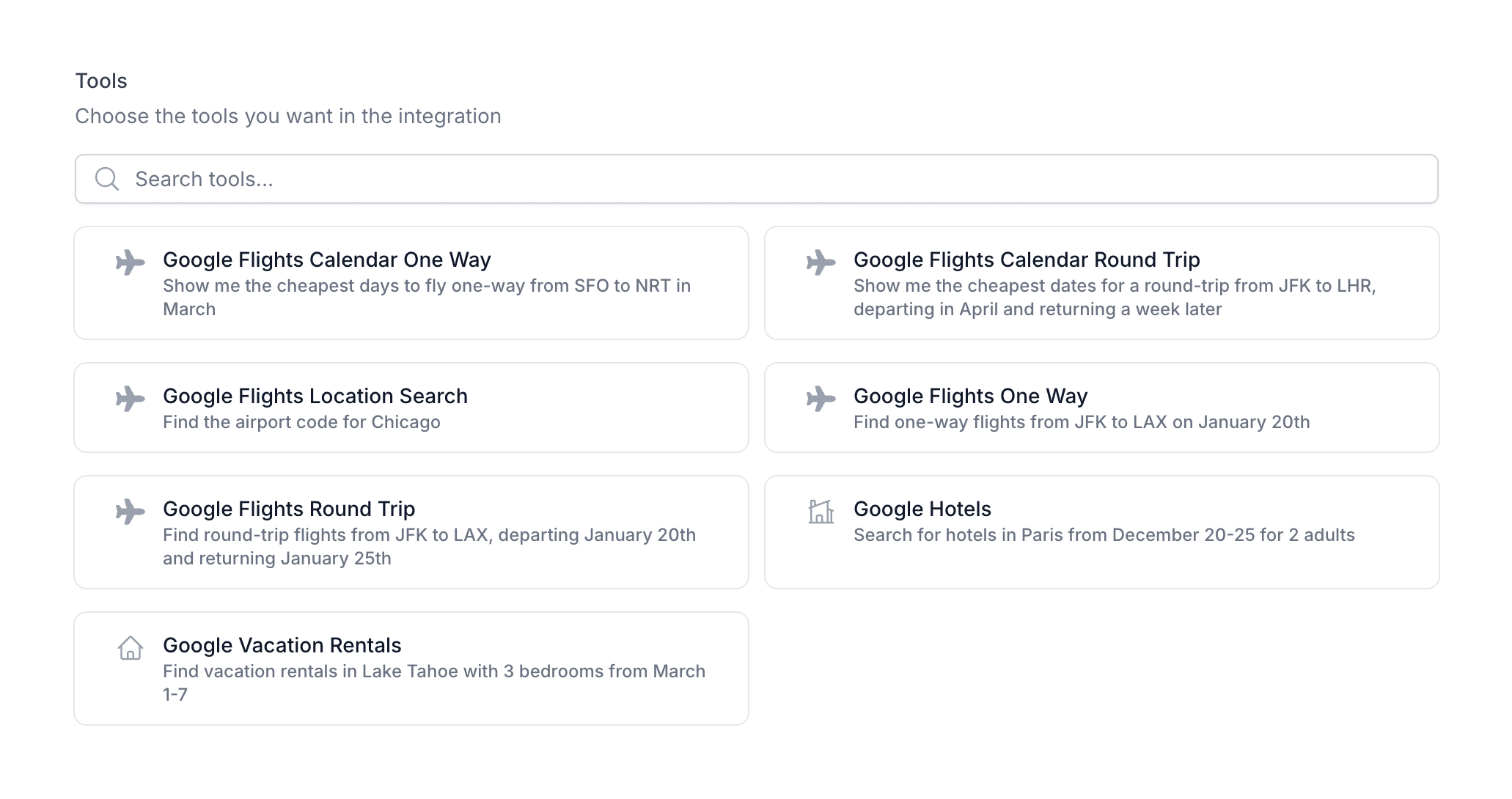
The Remote MCP Integration enables AI assistants to call SearchAPI tools directly through the Model Context Protocol."Find round-trip flights from NYC to Tokyo in March, under $1000, with one checked bag"
We're starting with travel (flights, hotels, vacation rentals), but this is just the beginning. We have 100+ APIs and will continue adding tools based on your needs.
What's a bundle?
A bundle is a collection of tools you connect to your AI assistant. We offer preconfigured bundles, such as Google Travel, but you can also build your own. Pick exactly the tools you need and create a custom bundle for your workflow.What we launched:
The Walmart Reviews API returns structured review, sentiment, and media data for a single Walmart product. It includes:
Product Data - The product object provides core fields such as title, product link, average rating, total review count, number of text reviews, recommendation percentage, media count, and a full star-rating histogram with per-rating counts and percentages.
Customer Reviews - The reviews.customer_reviews array returns individual reviews with review ID, title (when available), full text, rating, review dates (human-readable and ISO), user identifiers, user name, feedback counts, verification badges, seller information, fulfillment type, and item-level metadata.
Top Reviews - Dedicated top_positive_review and top_negative_review objects return representative customer feedback, including full review text, rating, timestamps, and reviewer metadata.
Aspect Statistics - The aspect_stats array highlights frequently mentioned product aspects (e.g. battery, handle, scratches) with occurrence counts, enabling topic-based analysis and filtering.
AI Review Summary - The ai_summary object provides an overview, including a title, natural-language summary, and aspect-level sentiment spans with polarity indicators.
Bullet Review Summary - The bullet_review_summary object groups feedback into pros, neutral points, and cons, each with standardized aspect names, polarity, and short summaries.
Review Media - The product_media array returns images submitted with reviews, including normal and thumbnail URLs and associated ratings.
Reviews - The reviews array returns individual page reviews with review ID, review link, recommendation status (recommend/doesn’t recommend), full review text, and review dates in both human-readable and ISO formats.
User Information - Each review includes a nested user object containing user ID, name, profile link (when available), and thumbnail image URL.
Engagement Metrics - Reviews return reactions_count and comments_count, allowing analysis of engagement and visibility per review.
HTTP Post Request
HTTP POST request support was added to address pagination limitations when working with large result sets.
When paginating through extensive datasets, the next_page_token can grow significantly in size (for example, 2KB → 5KB → 8KB+ per page). Passing large pagination tokens as URL query parameters can exceed URL length limits enforced by HTTP clients, browsers, proxies, CDNs, load balancers, or servers. This may result in errors such as 414 (URI Too Long) or 413 (Request Entity Too Large).
To mitigate this, POST requests allow pagination tokens to be sent in the JSON request body rather than the URL. This avoids URL size constraints and enables reliable pagination regardless of token length.
This approach is especially important for APIs with opaque or encoded pagination tokens (such as the Meta Ads Library API), where token size is not predictable and can increase across pages.
By supporting HTTP POST, pagination remains stable and consistent even when iterating through very large datasets.
🔧 Engine Improvements:
Google Search API
Fixed ai_overview selectors and improved extraction reliability
Fixed knowledge_graph selectors
Fixed related_questions selectors
Fixed inline_images selectors
Google AI Mode API
Fixed text_blocks.reference_indexes selectors
Fixed q request parameter encoding
Google Images Light API
Fixed an edge case that returned empty results
Google Lens API
Added has_exact_matches key when search_type=all
Fixed issues with incorrectly encoded URLs
Fixed country request parameter handling
Google Shopping API
Fixed shopping_results.product_id and shopping_results.prds values
Google Product API
Fixed an issue returning empty results
Google Product Offers API
Fixed offers.extracted_delivery_price selectors
Fixed offers.delivery_price selectors
Added new keys: promo_code, promo_discount, extracted_promo_discount, promo_expires
Google Maps API
Fixed edge cases when results were empty
Fixed ads selectors
Google Maps Reviews API
Fixed topics extraction
Google News API
Added new countries for hl request parameter validation
Bing Search API
Fixed local_results selectors
Fixed organic_results selectors
Fixed knowledge_graph selectors
Bing Images API
Fixed images.source.link selectors
Airbnb Search API
Improved edge cases when results were not returned
Apple Product API
Fixed app_details.logo cases
Fixed product.videos extraction
Amazon Product API
Fixed product.variants cases
Amazon Offers API
Fixed an edge case returning empty results
eBay Search API
Fixed organic_results.reviews and organic_results.price extraction
eBay Product API
Added a fallback for product.product_id retrieval
YouTube Transcripts API
Fixed requests returning empty results
TikTok Ads Library API
Fixed an edge case where responses returned no results
The Airbnb Property API returns detailed structured data for a single Airbnb listing. It includes:
Property Data - The property object provides core fields such as id, title, description, link, rating, review count, guest_capacity, and accommodations (room type, beds, bath).
Amenities - A normalized amenities array, where each item includes name and is_available. This allows consistent feature parsing across listings.
Ratings - Category-level ratings are available under property_ratings, including cleanliness, accuracy, check-in, communication, location, and value.
Rules & Safety - house_rules contains check-in/checkout times, check-in method, and stay restrictions. safety_policies lists safety devices or requirements (e.g., smoke alarm, CO alarm).
Location & Images - gps_coordinates return latitude and longitude. The images array includes captioned image URLs for building galleries or media displays.
Host Information - A separate host object provides host ID, name, profile URL, bio, verification flags, rating, review count, hosting duration, response metrics, and avatar URL.
The structure is consistent with other accommodation APIs (e.g., Google Hotels Property), making it easy to reuse data models across different APIs.
The Airbnb Reviews API returns structured review data for a single Airbnb listing. It includes:
Review Metadata - The search_information object exposes the total number of reviews available for the property.
Reviews - Each review entry includes review_id, full text, language, rating, relative and ISO timestamps, and a nested user object containing id, name, profile_link, details, and avatar.
User Data - The user object standardizes reviewer information across listings, including unique identifiers and profile metadata.
Sorting Options - Reviews can be ordered using the sort_by parameter. Supported values are most_relevant (default), most_recent, highest_rating, and lowest_rating.
Topic Filtering - The topic_id parameter filters reviews by a single topic. Topics (e.g., location, cleanliness, hospitality, amenities, comfort, value, walkability, etc.) are provided in the topics field when available. topic_id cannot be used with the q search parameter.
The structure is consistent with other review-related APIs, making it straightforward to reuse filtering, pagination, and user-data handling logic across different APIs.
Image Preview - The image_preview object contains the main image (link, width, height) and a list of detected crops. Each crop includes a category, crop_id, is_product flag, and normalised crop coordinates.
Object Detection - Crops returned in image_preview.crops represent detected objects within the image, such as furniture items or decor elements, with associated labels and bounding regions.
Visual Matches - The visual_matches array lists visually similar items from external sources. Each result includes position, title, snippet, source domain, link, thumbnail, and a high-resolution image object.
Related Searches - The related_searches array provides image-based query suggestions from Yandex, each with a title and direct search link.
Similar Images - The similar_images array contains image search result pages that match the original input closely. Each item includes position, link, thumbnail, and an image object.
The structure mirrors Google Lens API keys, providing consistent fields for detected objects, similarity ranking, and related visual content across APIs.
Page Data - The page object provides core fields such as id, name, page link, follower count, following count, and links to follower/following lists. It also includes profile and cover photo URLs in both original and page-link formats.
Followers & Following - Follower and following objects include text labels, direct links, and numeric counts, enabling consistent parsing of engagement metrics.
Photos - The API exposes profile_photo_original, profile_photo_link, cover_photo_original, and cover_photo_link for retrieving image assets or linking directly to Facebook-hosted media.
About Information - The about object contains formatted categories, address, coordinates, phone number, website, review metrics (rating percentage and total reviews), and price range.
Location Data - gps_coordinates returns latitude and longitude for map-based features or store locators.
The Google Shorts API returns short-form video results surfaced in Google Search. It includes:
Shorts Results - Each entry in the shorts array provides position, title, link to the original video, source platform (e.g., TikTok), author/creator name, video length, and a thumbnail for preview rendering.
The Google Books API returns structured book results from Google Books search. It includes:
Organic Results - Each item in organic_results provides position, book id, title, link to the Google Books page, publication date, and optional extensions such as author and year.
Authors - The authors array includes each author's name and a link to their author-specific Google Books search page.
Book Metadata - Additional fields such as snippet, extensions, and publication date provide concise book information suitable for previews or summaries.
Related Links - The other_links array includes links such as preview pages, additional editions, or alternate book formats.
Thumbnails - A thumbnail field is available for displaying book cover previews, returned as a base64 image or external image URL.
🔧 Engine Improvements:
Google Search API
Fixed local_news selectors.
Added local_news.iso_date and perspectives.iso_date fields.
Fixed local_results parsing for device=mobile requests.
Google News API
Added top_stories.iso_date and organic_results.iso_date fields.
Google Shopping API
Fixed extraction of shopping_results.seller_favicon.
Improved extracted_price handling in edge cases.
Google Product Offers API
Improved offer extraction when product_token is obtained through product variations.
Google Lens API
Fixed an edge case where results were not returned.
Google Maps API
Fixed local_results.ludocid extraction in edge cases.
Added only_available request parameter to return any available transcript for a video.
Apple Product API
Updated parsers to accommodate UI changes. All existing keys remain unchanged.
Walmart Search API
Fixed issues affecting the page request parameter.
Database Infrastructure Upgrade
We upgraded our primary database on December 1, 2025, to resolve intermittent HTTP 500 errors affecting approximately 0.0001% of requests, caused by connection exhaustion under high load.
Maintenance Window (UTC)
Start: December 1, 2025, at 11:00 UTC
End: December 1, 2025, at 11:13 UTC
We use AWS RDS Multi-AZ, which performs automatic failover during upgrades and typically completes in under 60 seconds. We didn't observe any noticeable disruption during the switch.
The new instance runs on a newer-generation CPU with significantly improved performance characteristics. Early metrics already show reduced request latency across API endpoints, and we're planning additional performance optimisations in the coming months.
This upgrade also provides the capacity headroom we've planned for the next 12 months of growth.
⏭️ What's coming next?
Walmart Reviews API
Facebook Business Page Reviews API
Instagram Profile Posts API
TripAdvisor API
Airbnb Experiences API
Airbnb Services API
TikTok Transcripts API
Stay tuned for more updates! As always, we're committed to providing you with the best experience.
November 2025: Update
New
Today, we're thrilled to update you on some of the newest engines, improvements, and give you a sneak peek into what’s coming next.
The Google AI Overview API returns Google’s new AI-generated summaries directly from search results. It provides:
AI-Generated Summaries - answers generated by Google’s AI. Each summary is divided into text_blocks: paragraphs, headers, or lists, preserving Google’s full logical structure.
Linked References - Every fact and section includes a reference_indexes array linking to authoritative sources, such as Wikipedia, YouTube, or media outlets. These are available under the reference_links field, which includes each source’s title, link, snippet, and domain.
Related Searches - Contextual follow-ups surfaced by Google’s AI, accessible through the related_searches array, each with its own query text and search link.
Structured Text Elements - Responses are organized into semantic blocks:
paragraph - a standalone text answer, optionally with a link.
header - section titles within the AI Overview.
unordered_list - bullet points with nested items (each a paragraph block).
Markdown Output - The API also returns a markdown field, giving the AI-generated summary in formatted Markdown.
The structure is the same as in Google ai_overview field, ensuring compatibility with the main Google Search API and making it easy to integrate.
The Airbnb API returns real-time property listings from Airbnb search results, including prices, ratings, and availability. It provides:
Property listings - Each result includes title, description, price breakdown, rating, reviews, accommodations, coordinates, badges (like Superhost), and image URLs.
Pagination - next_page_token for fetching additional results.
Field structure follows the same pattern as other travel APIs (e.g. Google Hotels), making it easy to reuse the same data model across platforms.
The Google Maps Directions API returns detailed route information between locations, including driving, transit, walking, and flight options. It provides:
Travel modes - Driving, Transit, Flying, and more, each with estimated durations and distances.
Places info - Start and destination points with addresses and coordinates.
Directions - Step-by-step routes with instructions, distances, durations, routes via highways or lines, and warnings.
Transit details - Full trip segments including departure/arrival times, vehicles, service providers, intermediate stops, buy ticket links, and time zones.
Flights data - Direct flight segments with airlines, prices, and a flights_link to Google Flights.
The Google News Portal API returns full article listings, menus, and topic data from Google News pages. It includes:
Organic results - News articles with title, link, thumbnail, publication date (iso_date), source info (name, favicon, authors), and optional section or story_token fields.
Menu and topic data - menu_topics, related_topics, and sub_menu_sections provide navigation tokens used to fetch related or localized sections.
Related publications - Lists associated outlets or magazines (related_publications).
Social and interactive data - posts_on_x for embedded posts and frequently_asked_questions for article-related Q&A content.
All fields and layouts follow the same structure used in other Google News-related APIs.
The Google Forums API returns discussion-style results from community platforms like OpenAI Community and other forums surfaced on Google. It provides:
Organic results - Forum threads with title, link, source, domain, snippet, date, and optional sitelinks for related posts.
Related searches - Follow-up queries users commonly explore on similar topics.
Pagination - Links to the next set of forum results.
All keys are consistent with the Google Search API.
🔧 Engine Improvements:
Google Search API
Fixed related_questions when AI generates an answer.
Google has deprecated the num parameter in standard search requests, which disrupted rank trackers and made it unreliable to fetch more than the default results. Our new Google Rank Tracker API solves this by letting you retrieve up to 100 organic results in a single request.
Highlights:
Organic results – identical JSON keys and fields as the Google Search API
Flexible results control – specify how many results to return (up to 100)
Consistent structure – no integration changes required
Context As of September 11, 2025, Google began phasing out the num=100 parameter. Many SEO tools relying on it have shown gaps, inflated impressions, corrections, or required multiple requests to achieve the same output. Our API maintains the browser session and returns 100 results by default (configurable), ensuring uninterrupted rank tracking while others adapt.
The Google AI Mode API returns results from Google’s new AI-generated answers interface (the “AI Overview” style results). The response includes generated text blocks, references, and supporting content, alongside regular search results. It provides:
Text Blocks - Structured AI output, returned as paragraph, header, code_blocks, unordered_list, etc. Each block contains the generated content and optional reference_indexes mapping back to sources.
Markdown - Combined structured text blocks available as a single markdown string.
Reference Links - Sources cited by the AI, including title, link, snippet, and source.
Web Results - Standard organic search results (title, link, displayed_link, source, snippet).
Local Results - Place listings with position, title, link, rating, reviews, price, type, address, and is_closed.
Inline Shopping - Product listings with position, title, link, rating, reviews, price, extracted_price, and optional original pricing fields.
Google Product, Offers, Reviews, Specs APIs changes
The Google Product, Offers, and Reviews APIs have been migrated to the new Google Shopping UI. Existing keys remain unchanged, and behavior is consistent with previous versions. The separate GoogleProduct Specs API has been deprecated. All specifications are now included in the Google Product response when using the product_token parameter. Here are the latest changes for every engine:
product_id and prds parameters are still supported and continue to return offers and essential product information.
Use the product_token parameter from the Google Shopping API for more detailed product data, including specifications, variations, review_results, and more.
All product specifications are now included directly in the Product API (Specs API is no longer available).
The Bing Videos API returns video search results from Bing, with structured data for videos, ads, and recommendations. It provides:
Video Results – Each video includes position, title, link, snippet (description), length, source (e.g., YouTube), date, channel, views, and a thumbnail.
Shorts – Compact video results in short format, with position, title, link, channel, views, duration, and thumbnail.
Suggestions – Related search topics with quick-access links and preview thumbnails for refining the query.
Ads – Sponsored video listings with position, title, link, tracking_link, displayed_link, snippet, sitelinks (extra links), and extensions (additional highlights).
JSON keys are kept the same as in the Google Videos API.
🔧 Engine Improvements:
Google Search API
Fixed answer_box keys when type=currency_converter.
Google Images API
Fixed an issue where the first page did not return images.
Google Lens API
Fixed support for search_type=all requests.
Added support for an additional Google Lens layout.
Google Shopping API
Added include_favicon request parameter.
Added new Sort By values in filters.
Updated product_link and offers_link paths to match the new UI format.
Google Flights API
Fixed a case where passing a kgmid value prevented flights from being returned.
Google Ads Transparency Center API
Fixed an issue where empty responses were returned.
Amazon Offers API
Fixed an issue where pagination was incorrectly included on the last page.
Google Play Store API
Added a new layout for searching for specific apps.
Added organic_results.logos key.
Google Play Product API
Fixed product.description key.
Baidu Search API
Fixed pagination.next key.
DuckDuckGo API
Improved request reliability.
⏭️ What's coming next?
Google AI Overview API
Google Place API
Google News Portal API
Google Maps Directions API
TikTok Profiles API
TikTok Video Transcripts API
Facebook Business Page API
Instagram Profile API
Walmart Reviews API
Stay tuned for more updates! As always, we're committed to providing you with the best experience.
September 2025: Update
New
Today, we're thrilled to update you on some of the newest releases and give you a sneak peek into what’s coming next.
A simplified version of the Google Videos API that returns only the essential data: title, link, snippet, length, and more. It delivers the same structure as the Google Videos API, making migration effortless. Thanks to the reduced payload, it offers faster response times.
The TikTok Ads Library API returns TikTok’s public ad data, making it easier to review campaigns, study competitors, and track creative trends. It offers:
Ad Listings – Advertiser name, ad ID, first/last shown dates, cover image, and video link.
Audience Reach – Estimated audience size ranges with min/max values.
Advertiser Details – Advertiser ID, business name, and campaign filters like country, time period, and page.
Creative Assets – Direct links to video files and thumbnails for review and analysis.
The Google Shopping Filters API returns all available filters for a shopping query, including those hidden in the standard Google Shopping API. It provides:
Filter Results – Organized by type (e.g., Category, Brand, Price).
Options – Each filter option contains a label (e.g., PlayStation Controllers, PlayStation Games, Video Games) along with a shoprs token that can be used to refine the search.
JSON keys are kept the same as in the Google Shopping API for seamless integration.
🔧 Engine Improvements:
Google Search API
Fixed ads.link selectors.
Google Lens API
Fixed exact_matches with safe_search=off request parameter.
Google News API
Fixed organic_results selectors.
Fixed search_information.total_results and search_information.time_taken_displayed selectors.
Google Hotels API
Added bounding_box request parameter, allowing hotel searches within specific coordinates.
Fixed an edge case where hotels did not return any results.
Google Flights API
Fixed an edge case with the booking_token in separate_tickets cases.
Google Finance API
Fixed knowledge_graph.about.currencies selectors.
Google Ads Transparency Center API
Fixed an edge case when the API didn't return any results.
Amazon Search API
Fixed organic_results.reviews selectors.
Amazon Product API
Fixed product.reviews selector.
Baidu Search API
Added organic_results.start_reading_link and organic_results.latest_chapter_link.
Bing Search API
Fixed organic_results.title and organic_results.link selectors.
Added answer_box key.
Other
Added YouTube OpenApi specs.
⏭️ What's coming next?
Yandex Search API
Google AI Mode API
Google Place API
Google News Portal API
Google Maps Directions API
Bing Videos API
Walmart Reviews API
OpenApi specs
Stay tuned for more updates! As always, we're committed to providing you with the best experience.
August 2025: Update
New
Today, we're thrilled to update you on some of the newest additions and give you a sneak peek into what’s coming next.
A simplified version of the Google Images API that returns only the essential data: image titles, thumbnails, source domains, and original image links (mobile only). It delivers the same structure as the Google Images API, making migration effortless. Thanks to the reduced payload, it offers significantly faster response times.
A simplified version of the Google News API that returns only the essentials: article titles, links, sources, publish dates, snippets, and thumbnails. With the same JSON structure as the Google News API, it’s easy to switch or scale. Optimized for speed and simplicity.
The LinkedIn Ad Library API provides structured access to sponsored content from LinkedIn advertisers. Built for transparency and ad intelligence, it offers:
Ad Listings: Headlines, creatives (images), call-to-action text, and destination URLs.
Advertiser Details: Includes advertiser name, logo thumbnail, and unique ad IDs.
Ad Types: Supports both image and rich text formats from public ad disclosures.
Media & Descriptions: High-resolution images, short/long descriptions, ingredients, and marketing highlights.
Reviews & Ratings: Top positive and negative reviews, average rating, total count, and review metadata.
Fulfillment Options: Real-time delivery and pickup details with expected dates and item limits.
Variants & Attributes: Full variant trees (e.g. pack size), unit pricing, subscription eligibility, and badges like “Best Seller.”
JSON format matches our Amazon Product API for easier migration.
YouTube Trends API is Deprecated
The YouTube Trends API has been deprecated following YouTube’s discontinuation of its Trending page in July 2025. This change reflects a strategic shift toward personalized discovery, driven by AI-based recommendations and genre-specific performance charts.
No Global Trending: The static, one-size-fits-all trending feed has been retired.
Personalized Surfacing: Content discovery is now tailored to user preferences, location, and viewing history.
New Creator Tools: YouTube is rolling out features to boost visibility through contextual promotion rather than global rankings.
API Impact: The youtube_trends engine is no longer supported.
You can always contact us and let us know if you'd like us to add or change something based on your specific use case.
🔧 Engine Improvements:
Google Search API
Fixed a bug where ads.block_position = bottom_ads was incorrectly extracted.
Resolved extraction issues for organic_results.sitelinks.inline on device=desktop.
Fixed the extraction of organic_results.sitelinks.expanded on device=mobile.
Google Lens API
Fixed extraction for search_type=exact_matches.
Fixed extraction for search_type=visual_matches and search_type=products when used with the q request parameter.
Google Maps API
Addressed a rare edge case that returned empty results.
Google Patents API
Fixed extraction of organic_results.title, organic_results.snippet, and organic_results.inventor.
Google Events API
Added support for the chips request parameter.
Fixed extraction of events.address and events.location.
Google Finance API
Fixed a bug where the summary field returned no results.
Google Ads Transparency Center API
Resolved an edge case that resulted in an error response.
Bing Search API
Added initial support for advanced search operators, like site: in the q parameter. Response time is currently high; optimizations are in progress.
Amazon Product API
Fixed extraction of product.coupon_text.
Naver Search API
Fixed extraction of organic_results.title, organic_results.link, organic_results.source, and organic_results.sitelinks.inline.
⏭️ What's coming next?
AI Overview
Yandex Search API
Google Place API
Google News Portal API
TikTok Ads Library API
Google Maps Directions API
Bing Images API
Google Videos Light API
OpenApi specs
Stay tuned for more updates! As always, we're committed to providing you with the best experience.
July 2025: Update
New
Today, we're thrilled to introduce 4 new engines, highlight recent engine fixes, and share what's coming next.
A stripped-down version of the Google Search API returning only core results: organic listings, knowledge graph, answer boxes, and related questions. Thanks to the reduced payload, it delivers faster responses and lower latency. Ideal for LLM integrations and content retrieval workflows.
Performance & infrastructure updates
We’ve made backend upgrades to scale more efficiently, improve response times, and prepare for significantly higher traffic.
Infrastructure scaling tested up to 5k QPS
API caching added
Removed all DB-level write/read locks
Deeply profiled the API to remove any bottlenecks
Next milestone: 10k QPS test this month
Work included multiple weekend sprints. We're happy with the results.
Google Search API Performance Improvements
Amazon Product API Performance Improvements
Zero retention mode (Enterprise only)
A high-compliance mode available via zero_retention=true (custom Enterprise contracts only).
A special parameter on our side enables ZDR mode. (zero_retention=true)
Request parameters are held in memory only.
HTML and JSON are deleted after response is built.
No logs at application, infrastructure, or subprocessor level
Continous Integration (CI) checks on every commit that identify data retention regressions
Manual infrastructure audits added for safety
For debugging, send zero_retention=false and we’ll log & save in the usual way.
Whether a user types “Hilton Hawaiian” or explores related searches like “Hilton fireworks”, the API guides them toward relevant, bookable destinations in real-time.
Just like with Google Flights and Google Maps, we've kept the API structure and field names familiar and consistent so you can integrate faster and with less friction.
We've expanded our Google Flights support by adding the Google Flights Calendar API. This API provides structured fare insights to help users find the best travel deals with ease. The API delivers key data, including:
Departure and return dates
Prices for different date combinations
Lowest available flights
No-flight indicators
The Google Flights Calendar API works with our Google Flights API, delivering structured pricing data in a consistent JSON format across our travel search engines.
Google Ads Transparency Center API helps you track ads, see where they appear, and learn more about advertisers. The API delivers key data, including:
Advertiser details (name & ID)
Domain
When ads appeared (first & last seen dates)
Ad format (text, image, or video)
Image of an ad
A direct link for more details
Whether you're tracking market trends, ensuring ad compliance, or just curious about online ads, this API gives you the insights you need—all in a structured JSON format.
This API works with the Google Trends Trending Now API and requires a news_token for access. It provides structured JSON data for tracking trending news articles.
🔧 Engine Improvements:
Google Search API
Added a new optimization_strategy query parameter. optimization_strategy=ads allows us to offer the best ad scraping rate in every country. Tradeoff is a slight latency increase.
The Google Trends Trending Now API provides real-time trending search topics. It provides:
Trending search queries
Search volume estimates
Percentage increases in interest
Associated categories
Trending locations
Related keywords
Active trend status & start date
You can track trends across different timeframes, including the past 4 hours, 24 hours, 48 hours, and 7 days. Whether you're monitoring breaking news, analyzing search interest, or integrating trends into your app, this API gives you a clear picture of what people are searching for right now.
Google Requires Javascript for Search Results
As of January 16, 2025, Google now requires JavaScript to display search results. This change impacts users with JavaScript disabled, including those relying on accessibility tools or using certain SEO rank-checking solutions. Google claims this move will improve search result quality and protect against bots and spam.
This update caused disruptions across the SERP API industry, affecting most providers. SearchApi, however, is fully equipped to handle JavaScript-based scraping. Our system integrates headless browser technologies and advanced proxy management to ensure reliable, high-performance data delivery, even under these new constraints.
🔧 Engine Improvements:
Google Search API
Added knowledge_graph.is_entity_closed and operational_status to handle permanently and temporarily closed cases.
Added support for a new layout for organic_results.rich_snippets.extensions.
Added a check to ensure pagination.next is not returned if the next page has no results.
Fixed the issue where shopping_results.thumbnail would not return any images.
Fixed typo shopping_ads.installment.extracted_cost_per_moth and shopping_results.installment.extracted_cost_per_moth, corrected it to extracted_cost_per_month. Both cases are currently supported, but extracted_cost_per_moth will be removed next month.
Google Product API
Fixed typo in offers.installment, correcting extracted_cost_per_moth to extracted_cost_per_month. Both cases are currently supported but extracted_cost_per_moth will be removed next month.
Google Product Reviews API
Added the new filters key and the filter_token request parameter.
Google Images API
Fixed pagination in the unique cases.
Google Jobs API
Fixed pagination when the location request parameter is used.
Google Flights API
Added more cases to booking_options.baggage_prices.
⏭️ What's coming next?
Google Flights Calendar API
Google Hotels API
Enhanced Speed plans ⚡
Yandex Search API
Google AI Overview
Google Ads Transparency API
Base64 image hosting on our side. This will shorten the LLM context if you want to use raw JSON responses.
Infrastructure upgrades to improve scaling and lower latency.
Stay tuned for more updates. We're always working to improve SearchApi for you.