Existing customer? Sign in
Bing Copilot API
Access Bing Copilot's AI-generated answers with structured data- Structured text blocks and markdown formatting
- Reference links with source metadata
- Real-time AI answer extraction
          curl --get https://www.searchapi.io/api/v1/search \
  -d engine="bing_copilot" \
  -d q="what is blockchain"
Copilot Answer Data
Structured JSON responses
Extract Bing Copilot's AI-generated answers with text blocks, markdown formatting, and reference links.
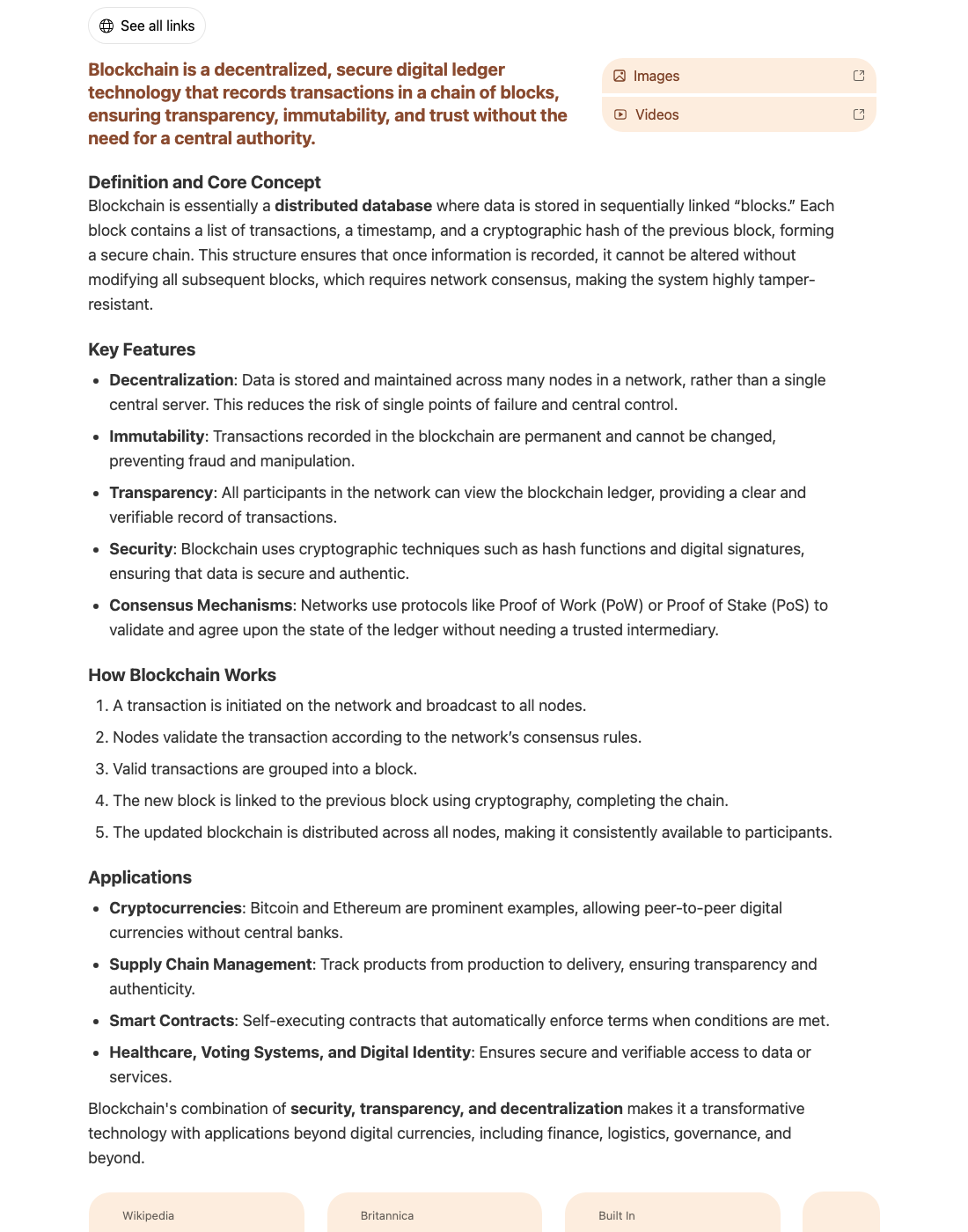
{
  "search_metadata": {
    "id": "search_875nmM02pVWXiEr4gwE4z1Yx",
    "status": "Success",
    "created_at": "2026-06-09T15:28:47Z",
    "request_time_taken": 14.12,
    "parsing_time_taken": 0.04,
    "total_time_taken": 14.16,
    "request_url": "https://www.bing.com/copilotsearch?q=what%20is%20blockchain&FORM=CSSCOP",
    "html_url": "https://www.searchapi.io/api/v1/searches/search_875nmM02pVWXiEr4gwE4z1Yx.html",
    "json_url": "https://www.searchapi.io/api/v1/searches/search_875nmM02pVWXiEr4gwE4z1Yx"
  },
  "search_parameters": {
    "engine": "bing_copilot",
    "q": "what is blockchain"
  },
  "text_blocks": [
    {
      "type": "header",
      "answer": "Blockchain is a decentralized, secure digital ledger technology that records transactions in a chain of blocks, ensuring transparency, immutability, and trust without the need for a central authority."
    },
    {
      "type": "header",
      "answer": "Definition and Core Concept"
    },
    {
      "type": "paragraph",
      "answer": "Blockchain is essentially a distributed database where data is stored in sequentially linked “blocks.” Each block contains a list of transactions, a timestamp, and a cryptographic hash of the previous block, forming a secure chain. This structure ensures that once information is recorded, it cannot be altered without modifying all subsequent blocks, which requires network consensus, making the system highly tamper-resistant."
    },
    {
      "type": "header",
      "answer": "Key Features"
    },
    {
      "type": "unordered_list",
      "items": [
        {
          "type": "paragraph",
          "answer": "Decentralization: Data is stored and maintained across many nodes in a network, rather than a single central server. This reduces the risk of single points of failure and central control."
        },
        {
          "type": "paragraph",
          "answer": "Immutability: Transactions recorded in the blockchain are permanent and cannot be changed, preventing fraud and manipulation."
        },
        {
          "type": "paragraph",
          "answer": "Transparency: All participants in the network can view the blockchain ledger, providing a clear and verifiable record of transactions."
        },
        {
          "type": "paragraph",
          "answer": "Security: Blockchain uses cryptographic techniques such as hash functions and digital signatures, ensuring that data is secure and authentic."
        },
        {
          "type": "paragraph",
          "answer": "Consensus Mechanisms: Networks use protocols like Proof of Work (PoW) or Proof of Stake (PoS) to validate and agree upon the state of the ledger without needing a trusted intermediary."
        }
      ]
    },
    {
      "type": "header",
      "answer": "How Blockchain Works"
    },
    {
      "type": "ordered_list",
      "items": [
        {
          "type": "paragraph",
          "answer": "A transaction is initiated on the network and broadcast to all nodes."
        },
        {
          "type": "paragraph",
          "answer": "Nodes validate the transaction according to the network’s consensus rules."
        },
        {
          "type": "paragraph",
          "answer": "Valid transactions are grouped into a block."
        },
        {
          "type": "paragraph",
          "answer": "The new block is linked to the previous block using cryptography, completing the chain."
        },
        {
          "type": "paragraph",
          "answer": "The updated blockchain is distributed across all nodes, making it consistently available to participants."
        }
      ]
    },
    {
      "type": "header",
      "answer": "Applications"
    },
    {
      "type": "unordered_list",
      "items": [
        {
          "type": "paragraph",
          "answer": "Cryptocurrencies: Bitcoin and Ethereum are prominent examples, allowing peer-to-peer digital currencies without central banks."
        },
        {
          "type": "paragraph",
          "answer": "Supply Chain Management: Track products from production to delivery, ensuring transparency and authenticity."
        },
        {
          "type": "paragraph",
          "answer": "Smart Contracts: Self-executing contracts that automatically enforce terms when conditions are met."
        },
        {
          "type": "paragraph",
          "answer": "Healthcare, Voting Systems, and Digital Identity: Ensures secure and verifiable access to data or services."
        }
      ]
    },
    {
      "type": "paragraph",
      "answer": "Blockchain's combination of security, transparency, and decentralization makes it a transformative technology with applications beyond digital currencies, including finance, logistics, governance, and beyond."
    }
  ],
  "markdown": "## Blockchain is a decentralized, secure digital ledger technology that records transactions in a chain of blocks, ensuring transparency, immutability, and trust without the need for a central authority.\n\n## Definition and Core Concept\n\nBlockchain is essentially a distributed database where data is stored in sequentially linked “blocks.” Each block contains a list of transactions, a timestamp, and a cryptographic hash of the previous block, forming a secure chain. This structure ensures that once information is recorded, it cannot be altered without modifying all subsequent blocks, which requires network consensus, making the system highly tamper-resistant.\n\n## Key Features\n\n- Decentralization: Data is stored and maintained across many nodes in a network, rather than a single central server. This reduces the risk of single points of failure and central control.\n- Immutability: Transactions recorded in the blockchain are permanent and cannot be changed, preventing fraud and manipulation.\n- Transparency: All participants in the network can view the blockchain ledger, providing a clear and verifiable record of transactions.\n- Security: Blockchain uses cryptographic techniques such as hash functions and digital signatures, ensuring that data is secure and authentic.\n- Consensus Mechanisms: Networks use protocols like Proof of Work (PoW) or Proof of Stake (PoS) to validate and agree upon the state of the ledger without needing a trusted intermediary.\n\n## How Blockchain Works\n\n1. A transaction is initiated on the network and broadcast to all nodes.\n2. Nodes validate the transaction according to the network’s consensus rules.\n3. Valid transactions are grouped into a block.\n4. The new block is linked to the previous block using cryptography, completing the chain.\n5. The updated blockchain is distributed across all nodes, making it consistently available to participants.\n\n## Applications\n\n- Cryptocurrencies: Bitcoin and Ethereum are prominent examples, allowing peer-to-peer digital currencies without central banks.\n- Supply Chain Management: Track products from production to delivery, ensuring transparency and authenticity.\n- Smart Contracts: Self-executing contracts that automatically enforce terms when conditions are met.\n- Healthcare, Voting Systems, and Digital Identity: Ensures secure and verifiable access to data or services.\n\nBlockchain's combination of security, transparency, and decentralization makes it a transformative technology with applications beyond digital currencies, including finance, logistics, governance, and beyond.\n\n[[0] - Blockchain - Wikipedia](https://en.wikipedia.org/wiki/Blockchain)\n[[1] - What Is Blockchain and How Does It Work? | Britannica Money](https://www.britannica.com/money/what-is-blockchain)\n[[2] - Blockchain: What It Is, How It Works, Why It Matters - Built In](https://builtin.com/blockchain)\n[[3] - Introduction to Blockchain Technology - GeeksforGeeks](https://www.geeksforgeeks.org/ethical-hacking/blockchain-technology-introduction/)",
  "reference_links": [
    {
      "index": 0,
      "title": "Blockchain - Wikipedia",
      "link": "https://en.wikipedia.org/wiki/Blockchain",
      "displayed_link": "https://en.wikipedia.org › wiki › Blockchain",
      "snippet": "Blockchains are typically managed by a peer-to-peer (P2P) computer network for use as a public distributed ledger, where nodes collectively adhere to a consensus algorithm protocol…",
      "source": "Wikipedia"
    },
    {
      "index": 1,
      "title": "What Is Blockchain and How Does It Work? | Britannica Money",
      "link": "https://www.britannica.com/money/what-is-blockchain",
      "displayed_link": "https://www.britannica.com › money › what-is-blockchain",
      "snippet": "Blockchain is a digital ledger database that records and distributes information in a secure and decentralized way. Learn how blockchain works, what industries can use it, and what…",
      "source": "Britannica"
    },
    {
      "index": 2,
      "title": "Blockchain: What It Is, How It Works, Why It Matters - Built In",
      "link": "https://builtin.com/blockchain",
      "displayed_link": "https://builtin.com › blockchain",
      "snippet": "Blockchain is a decentralized, immutable digital ledger that records and verifies data across a peer-to-peer network. Learn how blockchain works, why it matters, its types, use cas…",
      "source": "Built In"
    },
    {
      "index": 3,
      "title": "Introduction to Blockchain Technology - GeeksforGeeks",
      "link": "https://www.geeksforgeeks.org/ethical-hacking/blockchain-technology-introduction/",
      "displayed_link": "https://www.geeksforgeeks.org › ethical-hacking › blockchain-technology-introduction",
      "snippet": "Blockchain is a revolutionary technology that functions as a shared, immutable digital ledger. The name \"blockchain\" comes from its structure data is organized in blocks, with each…",
      "source": "GeeksForGeeks"
    }
  ]
}
Developer experience
Easy integration
Integrating is as simple as making a GET HTTP request.
https://www.searchapi.io/api/v1/search?engine=bing_copilot&q=what+is+blockchain- Python
- Node
- Ruby
- Java
- Go
- PHP
- Bash
- R
- Kotlin
- Swift
- C#
- C
- C++
- requests
import requests

url = "https://www.searchapi.io/api/v1/search"
params = {
  "engine": "bing_copilot",
  "q": "what is blockchain"
}

response = requests.get(url, params=params)
print(response.text)
Data Points
What you get
Access Bing Copilot's AI-generated answers with complete structured data.
-
Text Blocks
- Structured content blocks including paragraphs, headers, and lists
-
Markdown Formatting
- Complete markdown-formatted version of the Copilot answer
-
Reference Links
- Source links with metadata including titles, snippets, and sources
Legal Coverage
Legal Protection Guarantee
We accept legal responsibility for how SearchApi collects and parses publicly available search results, backed by up to $2M in coverage. This protection applies to customers worldwide, operates under U.S. law, and does not cover your use of the data or unlawful activities.
Simple Pricing
Pricing plans
- Pay per success
- Built in location geo-targetting
- Only premium proxies
- 10,000 Searches
- 99.9% SLA
- 35,000 Searches
- Team Management
- Legal Protection Guarantee
- 99.9% SLA
- 100,000 Searches
- Team Management
- Legal Protection Guarantee
- 99.9% SLA
- Medium Throughput
- 250,000 Searches
- Team Management
- Legal Protection Guarantee
- 99.9% SLA
- High Throughput
- Search Analytics
- 500,000 Searches
- Team Management
- Legal Protection Guarantee
- 99.9% SLA
- Dedicated Throughput
- Priority Support
- Search Analytics
- 1,000,000 Searches
- Team Management
- Legal Protection Guarantee
- 99.9% SLA
- Dedicated Throughput
- Priority Support
- Search Analytics
- 2,000,000 Searches
- Team Management
- Legal Protection Guarantee
- 99.9% SLA
- Dedicated Throughput
- Priority Support
- Search Analytics
- 5,000,000 Searches
- Team Management
- Legal Protection Guarantee
- 99.9% SLA
- Dedicated Throughput
- Priority Support
- Search Analytics
Trusted by industry leaders






Robust Infrastructure
Handle even the most demanding needs
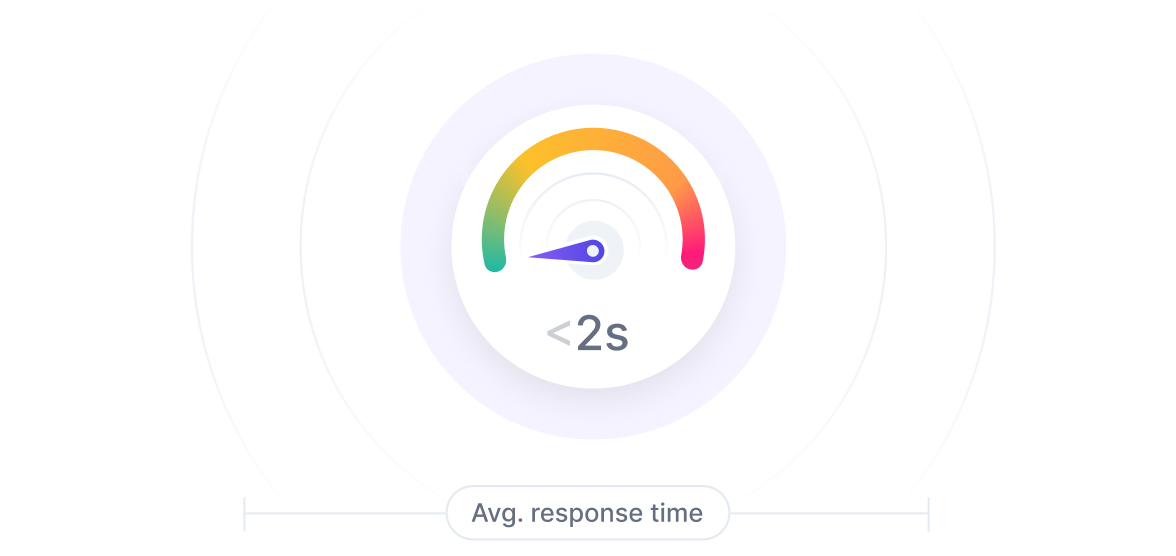
Performance
Sub-2 second average response time
Optimized for low latency, delivering rapid results for AI applications, SEO analysis, and research.
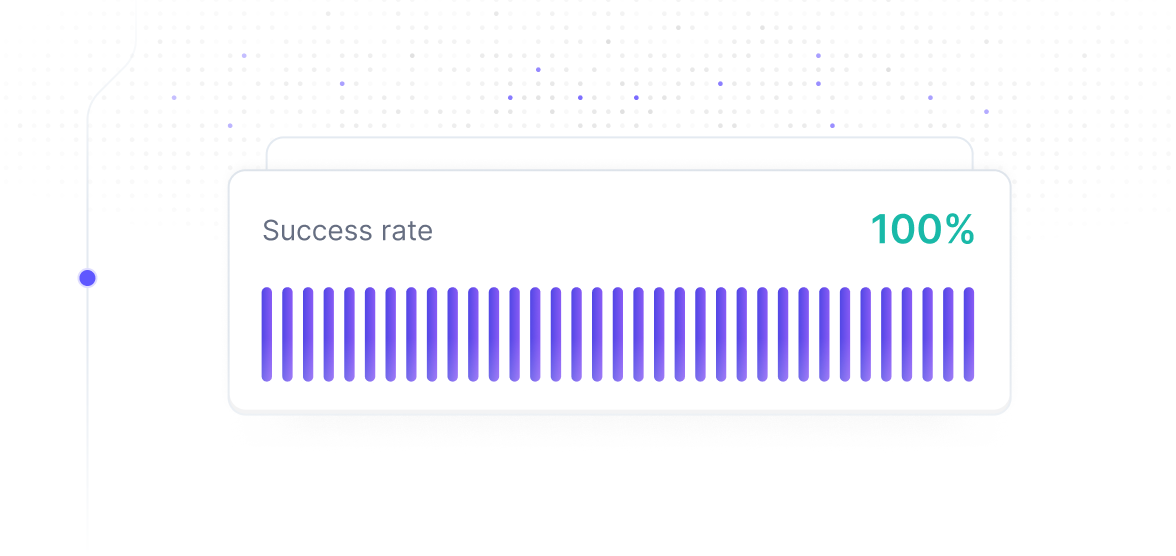
100% Success Rate
Guaranteed query completion
Guaranteed success with built-in auto-retry mechanism and adaptive error handling to ensure complete data collection.
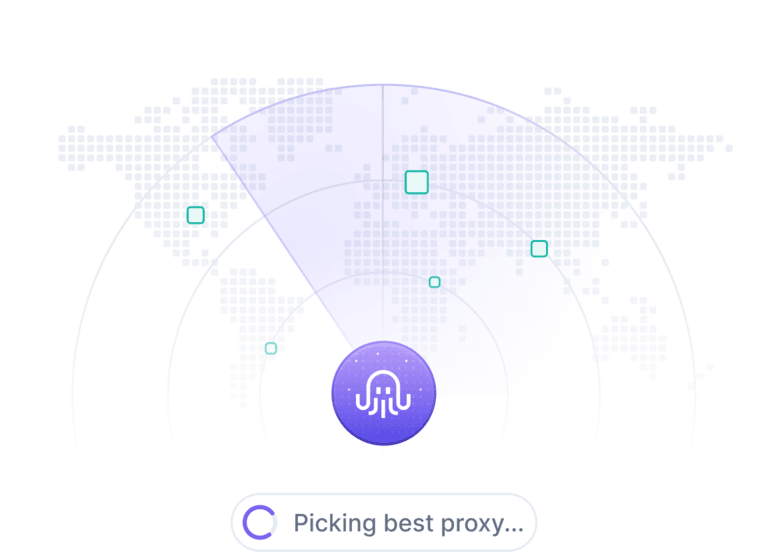
Proxy Management
Scalable proxy rotation
Our built-in proxy rotator and auto-retry mechanisms ensure scalability, handling millions of searches daily across a global network of 100M+ proxies.
Captcha Solving
Advanced CAPTCHA bypass
Mimics real human behavior with full browser rendering, JavaScript execution, and CAPTCHA solving for uninterrupted data scraping.
Integrations
Open-source integrations
Easily integrate with popular open-source tools like Dify, Flowise, LangChain, and Haystack to extend functionality with minimal setup.
Get started with SearchApi today
No credit card required. No commitment. Cancel anytime.